
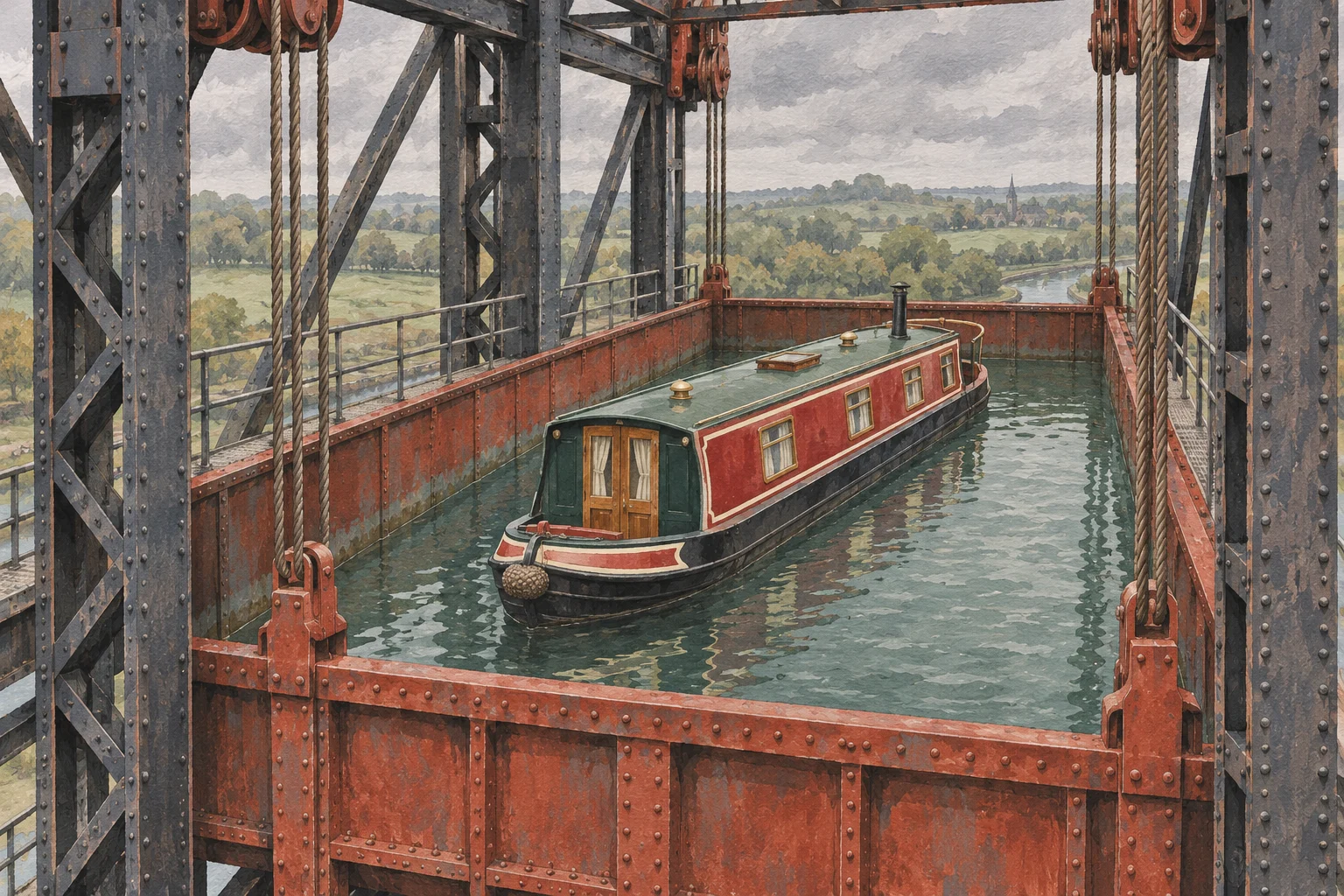
There are several perfectly respectable ways to move a boat uphill. You can work it through locks, for a start. Or, if you are feeling particularly Victorian, you can put the whole thing in a tank and arrange for the tank to go upstairs.
At Anderton, near Northwich in Cheshire, that second option became a piece of working infrastructure. The boat lift links the Trent & Mersey Canal with the River Weaver Navigation, fifty feet below. It is a wonderfully extravagant-looking answer to a very practical problem.
The temptation is to describe it simply as a big machine and stand back, suitably impressed. But the more interesting story begins with the cargo. Why was the machine needed? What did it replace? And why does keeping it useful turn out to be rather more complicated than admiring its ironwork?
This is a story about boats going vertically. It also involves salt, corrosion and the persistent inconvenience of having to maintain things. Any boat owner will recognise at least one of those themes.
So close, yet a long way apart
Look at two waterways on a map and it is easy to assume that proximity means connection. A few lines, a junction, job done. A map is less forthcoming about what happens when one stretch of water sits substantially above the other.
Historic England places the canal at Anderton 15.24 metres above the Weaver. Its account describes a site shaped by the transfer of goods, including salt chutes, inclined planes, basins and dockside features. The protected monument encompasses much more than the conspicuous lift.
Those details matter. Before the lift, the question was how to transfer the goods between boats at different levels. The lift offered a way to move the boats themselves, taking their cargo with them. You can appreciate the appeal without ever having earned your living loading a vessel.
Every transfer involves somebody doing the handling, somewhere to put the goods and time spent getting everything in the right place. An elegant route on paper can be an awkward business on the ground. Anderton makes that distinction visible on a spectacular scale.
It is worth remembering this when a modern journey planner makes an itinerary look suspiciously simple. The line is only the beginning. The physical connection is where the interesting work happens.
Bring the water with you
The lift opened in 1875, with Edwin Clark responsible for its hydraulic design. The Canal & River Trust’s historical account also credits Edward Leader Williams, the Weaver Trustees’ engineer, in developing the scheme and bringing Clark into the project.
The central idea was to carry boats in water-filled tanks, known as caissons. Each could accommodate two narrowboats or a barge. Rather than asking the boat to leave its natural element, the machinery moved a small piece of waterway with the boat still floating in it.
That is the useful starting point for understanding a boat lift. Imagine the boat’s immediate surroundings becoming the vehicle. You are carrying the container as well as its contents, with the engineering arranged around that task.
There is a pleasing lack of compromise in the idea. Somebody considered the height difference, the boats and the available technology, then proposed lifting the whole watery arrangement. It sounds faintly unreasonable until you see why it answers the problem.
If you enjoy machinery, the technical details are there to explore. If you do not, the basic concept is still enough to make you pause. A boat can have an upstairs destination. It just needs a much more elaborate lift than the one in a department store.
A machine with more than one lifetime
The structure has changed during its working life. The Trust records a conversion to electric operation in 1908, with counterweights and wire ropes forming part of the altered arrangement. Later restoration returned the lift to hydraulic operation, while retaining the 1908 structure and pulley wheels as a static monument.
That gives Anderton a particularly interesting sort of appearance. What you see is evidence of successive decisions, rather than a single untouched Victorian design. Different generations have left their solutions standing alongside one another.
There is a useful lesson here for anybody trying to read an old industrial site. The biggest or most visible part is not necessarily doing the job you assume it does. Some features explain how a machine worked before, rather than how it works now.
Ask which period a detail belongs to. Look for an interpretation panel or an explanation of the changes. You will get more from the visit than you would by trying to make every wheel fit your first guess.
Boaters, of course, are quite accustomed to discovering that a previous owner’s arrangement requires explanation. Anderton supplies a grander setting for the same basic question: what, precisely, is that bit for?
The bit the postcards leave out
In 1983, an inspection found serious corrosion and the lift was taken out of service. It reopened in March 2002 after restoration. Those dates, given in the Trust’s history, put nearly two decades between closure and return.
A restoration can look inevitable when the finished result is the thing you encounter. It is easy to skip mentally from an old photograph to a smart visitor attraction. The intervening years deserve a little more attention.
An industrial structure has materials, loads and working components. Bringing it back involves questions about what can be retained, what needs replacing and how it will be operated afterwards. The romance depends on people making unromantic decisions properly.
This is one reason a conserved machine can be more engaging than a pristine model. You can see the consequences of weather, changing technology and continued use. Its history includes the effort of keeping it in existence.
There is no need to turn every pleasant afternoon into a seminar on maintenance. Still, give the maintenance story a moment. Without it, there would be rather less to photograph and considerably less to argue about over the tea afterwards.
Before you plan a passage
Anderton’s operational position needs checking separately from its history. On 5 November 2026, the Trust’s Engineering the Future page reported a caisson-gate fault and a programme of work intended to return the lift to operation in summer 2027. That is a stated target, not a booking or a promise of passage.
The same page distinguishes that work from a wider redevelopment project, which it says has been paused. A plan to repair machinery and an ambition to transform a visitor site are different things. Treating them as interchangeable would make for a cheerful but unreliable itinerary.
Before travelling by boat, check current navigation notices and the lift’s official information directly. Before a visit ashore, check the visitor arrangements too. A site can have a story worth seeing even when a particular experience is unavailable, but you should know what you are setting out to do.
Keep the practical decision separate from the enthusiasm. You can be thoroughly taken with the engineering and still choose another route or another date. The machinery will not be offended. Your crew may be less forgiving if the entire holiday depends on an assumption.
Give the ordinary details a look
The scale is what gets your attention first. After that, try looking at the relationship between the parts: the approach from the canal, the difference in levels, the space a boat occupies and the surrounding evidence of trade.
There is a particular pleasure in understanding why something is where it is. A basin becomes a working space rather than an attractive patch of water. An aqueduct becomes the connection that makes the larger idea possible. The whole site begins to make sense as a place where people had things to get done.
Read the history before you go, then leave yourself time to look rather than racing through a checklist. You do not have to memorise every dimension. Remembering the problem the engineers were solving will take you a surprisingly long way.
Anderton earns its place in a boater’s imagination because the idea remains so direct. Two waterways were close together and inconveniently far apart. The answer was to lift a boat while letting it remain a boat, afloat in its own travelling patch of water.
It is a solution with considerable presence. And, for anyone who has ever muttered at a difficult lock, it offers an irresistible thought: perhaps the boat could simply take the lift.