
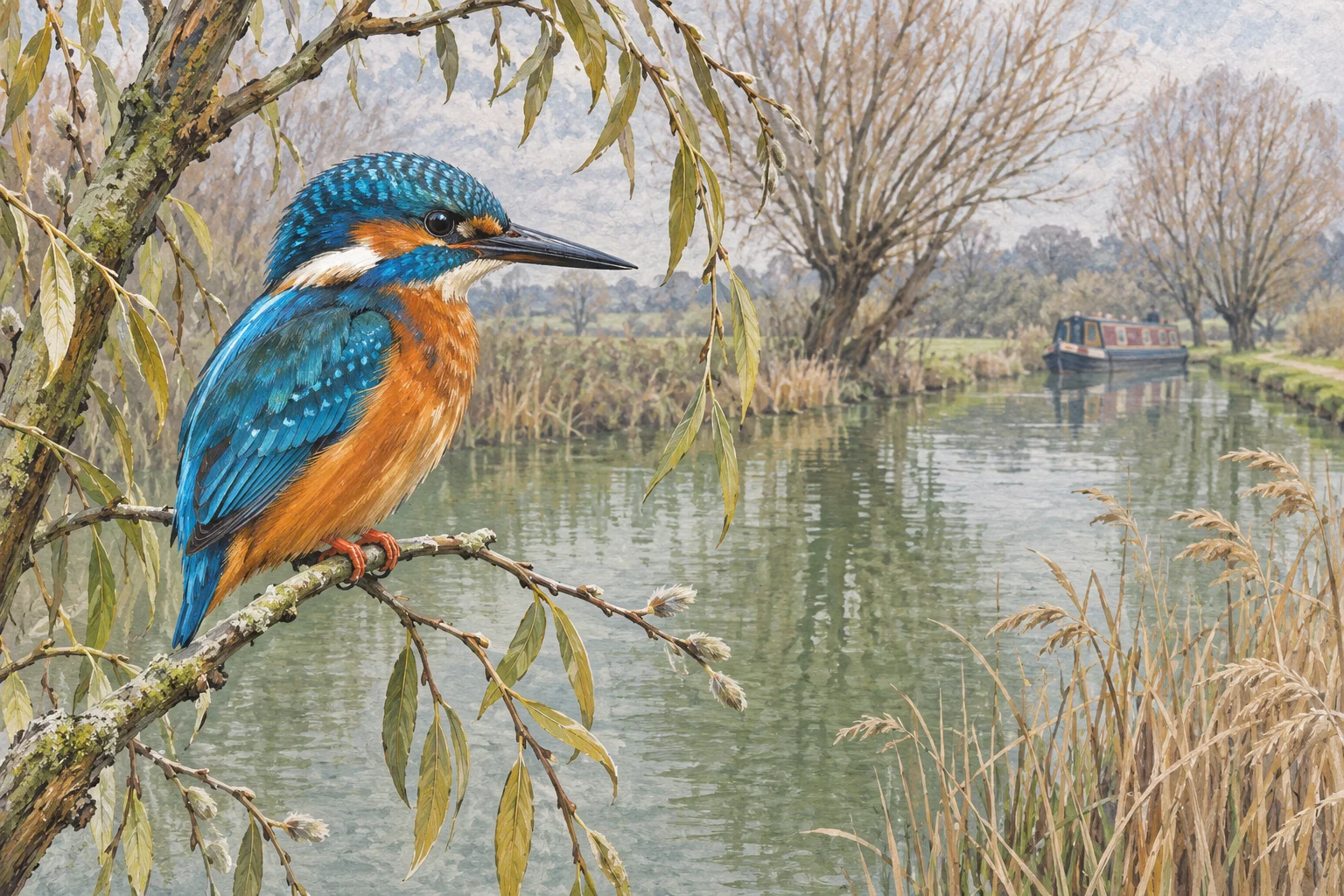
A kingfisher is remarkably good at becoming something you have just missed. Somebody points. You turn. There is a branch, some water and a very confident assertion that it was definitely there a moment ago.
For a bird with such conspicuous colouring, it has a fine sense of timing. It can turn a perfectly ordinary stretch of canal into the most interesting place you have seen all day, then leave before anyone has worked out where the binoculars went.
That is part of the pleasure. Boating gives you long, unhurried opportunities to notice the water’s edge. You may be passing the same reeds, branches and little gaps in the bank for minutes at a time. There is room to look properly, provided you are not the person who ought to be concentrating on the boat.
You do not need to become a dedicated birdwatcher to enjoy a kingfisher. A little familiarity helps, as does a willingness to stop demanding that the wildlife perform on schedule.
Smaller than the reputation
In a photograph, a kingfisher can fill the frame. On the canal, the frame is considerably larger. The Wildlife Trusts describes the bird as only slightly bigger than a house sparrow, which is a useful correction to the magnificent creature you may have built in your imagination.
The blue upperparts and orange breast are striking, but they do not make the bird equally obvious from every angle. The same Wildlife Trusts guide points out how inconspicuous it can be sitting on a perch, compared with the flash of colour when it moves.
That is a good reason to look at the shape of a bird as well as the colour. A compact body and a long, pointed bill may be more useful clues than waiting for something blue to announce itself.
Give yourself permission to be uncertain. If a small bird passes too quickly to identify, you have seen a small bird pass too quickly to identify. There is no prize for upgrading every glimpse into a confirmed sighting.
The pleasure improves when you stop treating it as an examination. Nobody is collecting your answers at the next bridge, although somebody aboard may still insist that theirs was a much better view.
The canal has a soundtrack
The Canal & River Trust advises listening as well as looking. A kingfisher’s high-pitched call can draw attention to a bird you have not yet spotted. Learning that sound gives you another way into the scene, particularly when your eyes are occupied with a promising branch.
Listen to a reputable identification recording before a walk, then put the phone away. The point is to recognise what you hear around you, rather than provide the canal with a continuous soundtrack from a small loudspeaker.
If you are aboard, keep the practical arrangements clear. The person steering needs to steer. Nobody should make a sudden dash along a gunwale because somebody else has said “there”. A good glimpse is a treat; it is not an instruction to abandon ordinary boat sense.
Let the sighting happen around the journey. There will be other stretches of water, and you will enjoy them more if everybody remains dry and unruffled.
Give an ordinary branch a chance
The Trust’s spotting advice recommends quiet observation around low, overhanging branches and slow water where a bird can find prey. That is more useful than searching for a scene that looks like a wildlife calendar.
A perch need not be picturesque to do its job. The branch you would crop out of a holiday photograph may be the very feature worth watching. Look at the water below it and the space around it, rather than assuming the tidiest view will hold the most interest.
Stay somewhere you can stand or sit comfortably without blocking the towpath. If you are constantly shifting position, making room for passers-by and rescuing your bag from a puddle, you have probably chosen a poor observation post.
There is no requirement to stare furiously at one twig. Let your attention move across a stretch of bank. Notice what changes, what returns and what you initially overlooked. The activity becomes enjoyable well before a kingfisher enters the picture.
This is a useful boating skill in its own right. Familiar water can look entirely different when you give it ten minutes without also trying to eat a sandwich, plan tomorrow and locate a missing windlass.
November is not a closed season for looking
A kingfisher is not simply a summer bonus. The British Trust for Ornithology describes kingfishers as resident in Britain and Ireland, with movement away from breeding territories outside the breeding period, particularly among young birds. Its species account records their presence throughout the year.
For a November walk, that is an encouraging distinction. You do not have to put the idea away with the folding chairs. Equally, a year-round presence does not mean every stretch of canal has a bird waiting beside it.
There is something particularly agreeable about noticing colour on a subdued day. Bare branches and grey water change the setting, even if you see no more than a brief movement across it. The canal does not need sunshine to reward attention.
And if you draw a blank, you have still been outside. That should count for something before the household committee begins assessing your results.
A hotspot is a starting point
The Trust’s list of reported kingfisher locations ranges from stretches of the Kennet & Avon to the Paddington Arm and the Lee Navigation. It also includes urban sightings, which is a useful reminder that wildlife does not always require a distant, conspicuously wild setting.
Use such lists as suggestions for places to look, rather than live reports. A location in a published guide cannot tell you what will be there on Thursday morning. It certainly cannot reserve a bird for the half-hour between arriving and deciding you need lunch.
If you are visiting a reserve, read the current visitor information before setting out. Access arrangements and facilities belong to the place you are actually visiting, not to the photograph that persuaded you to go.
For many boaters, the better starting point is closer to hand. Look properly at a stretch you already pass. Make a note of what you see and when, rather than assuming a more famous location must offer a better experience.
Leave the bird its own day
Wildlife watching works best when your excitement does not become the bird’s problem. Watch from a distance and let it decide where it goes next. If your next move would make it leave, reconsider the move.
The Trust specifically warns against approaching kingfisher burrows. For this sort of casual canal watching, there is no reason to seek a nest, inspect a bank hole or position yourself where a bird needs to come and go. Watching a feeding perch from well back is quite enough to be getting on with.
Resist the temptation to pursue a better photograph after a bird moves. The picture you did not get can remain a pleasant memory rather than a small campaign along the towpath. Binoculars can help you enjoy a view without closing the distance.
Be equally considerate with other people. Keep paths clear, give anglers room and avoid turning a quiet moment into a public announcement delivered at full volume. A discreet point and a few calm words will usually communicate the important part.
Then let the encounter finish. The most satisfying end to a sighting may simply be watching the bird carry on with its day while you carry on with yours, slightly more attentive than before.
You can come home without a photograph
There is an odd pressure to prove a good sighting. A blur on a phone becomes evidence; a clear memory apparently needs witnesses. It is a pity to spend the whole encounter trying to manufacture something to show afterwards.
Put the binoculars somewhere sensible, keep your camera ready if that is your pleasure, and allow yourself to choose watching when the moment arrives. You can remember the branch, the quick movement and the colour without bringing back a publishable image.
That applies to the rest of the canal too. Look at the reflections while you wait. Notice which birds you have stopped noticing because they are familiar. Spend a little time doing one thing rather than documenting how successfully you are doing it.
The kingfisher may appear. It may already have gone round the bend. Either way, you will have given an ordinary stretch of water more attention than it usually gets.
And the next time somebody points at an apparently empty branch, you might be just quick enough. Keep looking. The binoculars are probably exactly where you put them.