
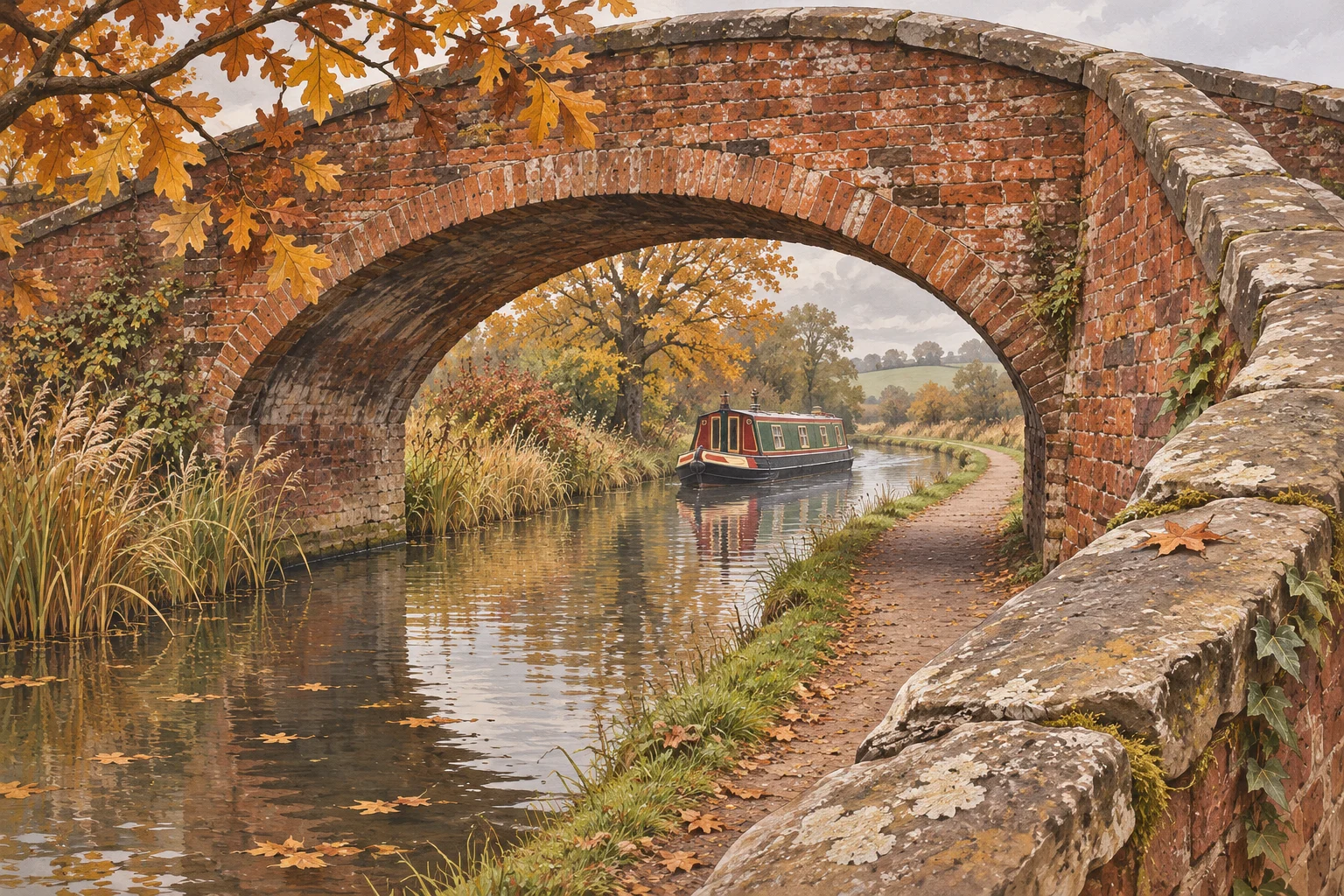
There’s usually somebody on the towpath who looks as though they own it. A dog with a stick wider than the bridge. A runner negotiating a puddle as if it were a personal insult. A boater carrying a cassette with the brisk, purposeful walk of someone who would rather not stop for a chat.
Before any of us arrived, the path had a rather specific job. It was where the engine walked.
The engine ate hay, required looking after and could not be persuaded to continue by turning a key. Horse towing helped shape the canals, including details that are still there beside the water. Once you start looking for them, an ordinary stretch becomes much more interesting. That odd curve in a bridge begins to make sense. So does a groove in the stone that you might otherwise mistake for damage.
You can spend a pleasant afternoon following these clues. There’s no need for a waistcoat, although the waterways have always been tolerant of a committed waistcoat.
A path with a job to do
The name is refreshingly literal. A towpath was a path for towing boats. The horse travelled along the bank, connected to the boat by a line, while the crew managed what was happening afloat. Today’s view of a quiet canal can make that arrangement look wonderfully leisurely. It was a transport system, with cargo to move and people depending on it.
London Canal Museum describes the early horse-drawn narrowboats as primarily cargo carriers, with some boats also providing passenger and parcel services. Its account of canal families explains that a crew member led the horse, sometimes a child. Picture that when the next lock feels like an unreasonable interruption to your holiday.
The romantic picture tends to leave out the labour. A horse was a working animal that needed care. The boat needed handling. Weather was something to work through, rather than a reason to relocate to the pub and reconsider the afternoon.
It’s easy to admire a painted cabin and miss the fact that it was somebody’s cramped home as well as part of their workplace. A decorative water can tells one part of the story. The family living and working around it tells another. Both deserve room in our idea of canal life.
The bridge that thought about the rope
A towpath doesn’t always stay on the same bank. For a walker, that means crossing a bridge. For a horse attached to a moving boat, it introduces a complication: the line has to come with you, preferably without wrapping itself around the structure.
The Canal & River Trust explains that turnover bridges, also called snake bridges, answered this problem. Their curving approaches allowed the towing arrangement to negotiate a change of bank. What now looks like a particularly handsome piece of canal architecture began as a practical response to a rope.
Elsewhere, split bridges provided a gap through which the towline could pass. The Trust points to examples on the Stratford Canal. A little slot can be easy to overlook when your attention is on a lock, yet it records a very different way of working the same water.
There’s something pleasing about engineering you can understand by imagining the task. No screen, no diagram with seventeen colours. Just a horse, a line and a bridge designed by somebody who had considered what would happen next.
On your next walk, follow the route of the path with your eyes. Look at how it approaches the bridge and where it emerges. The question isn’t simply how a person gets across. It’s how a towing team might have kept moving. Leave any close inspection until you’re safely ashore; the person on the tiller still has a boat to steer.
The marks the work left behind
The Trust’s historical towpath trail invites people to look for grooves made by towing ropes around bridges and tunnels. These are small traces of repeated work, rather than a grand memorial announcing itself from across the cut.
A groove is particularly good at shrinking the distance between then and now. You can imagine a line moving under tension against the same surface, journey after journey. The boat and horse have gone; the evidence of their passing has stayed behind.
Of course, not every scratch is a rope scar. Waterways have had repairs, alterations and plenty of ordinary wear. A convincing story is still only a story until the evidence supports it. Local heritage interpretation, an archive photograph or a museum explanation can help you work out what you’re actually looking at.
Take a photograph from a safe position, note the bridge number and look it up later. You may find an answer. You may discover that the feature you had confidently identified is nothing of the sort. That is a perfectly respectable result, and generally cheaper than buying a boat on the strength of confidence alone.
Let the people back into the picture
Looking for physical clues is enjoyable, but the story becomes thinner if it stops at attractive brickwork. There were people organising the journeys, handling boats and raising families within the demands of the trade.
The museum’s account connects families moving aboard with the economic pressure of railway competition. It describes the ingenuity of the boatman’s cabin while acknowledging the difficulties of sharing such a small space. That tension is worth keeping in mind when we admire the brass and paintwork.
A restored cabin can be beautiful. It can also make you reconsider the amount of equipment you claim is essential for a weekend away. There’s a difference between choosing a compact life afloat and having very little choice about the space available.
If you visit a canal museum, give the everyday objects some time. Ask what they were used for, where they fitted and who would have handled them. A useful question often opens up more than a quick photograph of the prettiest boat. The same applies to a conversation with somebody who knows the local waterway: listen before supplying your own theory.
The horse hasn’t entirely left
Horse towing survives in places, and it changes how you see the towpath. Devon County Council’s code for the Grand Western Canal specifically covers the horse pulling its passenger barge. This is a present-day working arrangement, with instructions for everyone sharing the bank.
The council tells people to stop and make way for the horse, keep to the hedge side and never step over the rope. Anyone wanting to overtake should wait for the horseman’s signal. Those details make the connection between bank and boat suddenly very real.
Treat that as local guidance for that canal, rather than assuming every waterway has the same arrangements. If you want to see horse boating, check with the operator before travelling. A page describing a tradition doesn’t tell you which trips are running on the day you happen to have free.
And give the people doing the work room to do it. An excellent photograph is a poor excuse for becoming part of the towing equipment.
Our turn on the path
The towpath’s job has changed, and the company along it has changed too. The Canal & River Trust describes its towpaths as shared spaces with pedestrian priority. Walkers, boaters, anglers and cyclists all feature in its account of how the paths are used now.
Knowing the history doesn’t give boaters ownership of the bank. It gives us another reason to be interested in it. The path remains a place where different journeys meet, sometimes in a space that was never generous to begin with.
The satisfying thing about this sort of history is how little ceremony it needs. Tie up somewhere suitable, make a cup of tea and go for a short walk. Notice the change of bank. Look at a bridge from the path as well as from the water. Read the small interpretation panel you’ve passed three times already.
You might find a rope scar. You might find nothing more dramatic than a well-built bridge doing its job. Either way, the canal has given you something to think about beyond the next water point.
And if a dog approaches with a branch the size of a lock beam, give it room. The towpath has been accommodating awkward loads for a very long time.