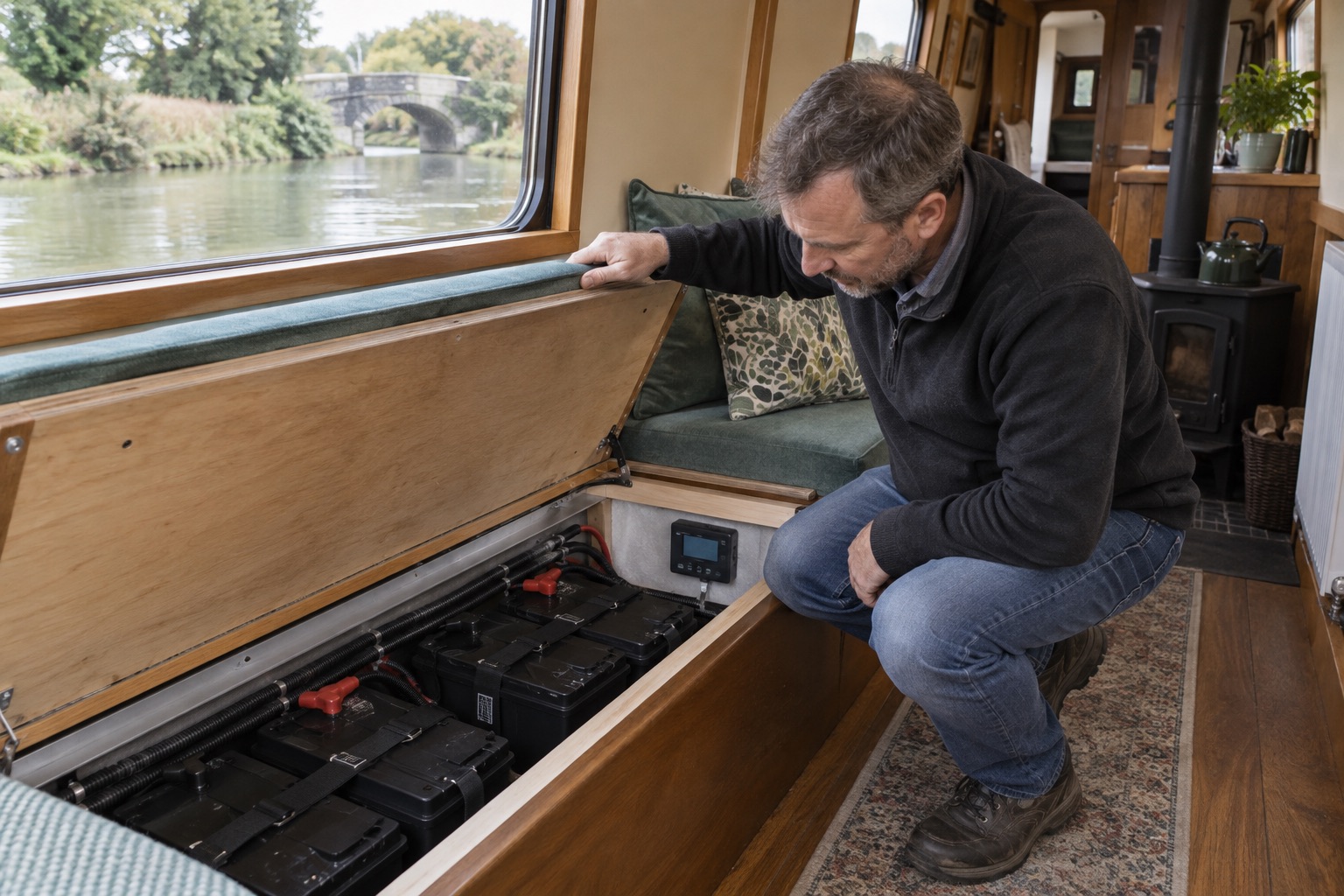
Separate the jobs
Many boats have a starting battery and a domestic bank. Learn which switches serve each, and avoid draining the starting supply with cabin loads.
Measure use and charge
List high-consumption appliances and check the charging sources fitted to the boat. Battery voltage alone can mislead while charging or under load; use the monitoring guidance for your system.
Keep installation safe
Battery connections, fuses and ventilation need the right marine specification. Have unfamiliar or damaged electrical work checked by a competent professional.
Work out a day’s electricity use
Multiply each appliance’s power in watts (W) by the hours it runs to find its energy use in watt-hours (Wh). Add the results for a daily estimate. Watts describe power at a particular moment; watt-hours describe energy used over time.
The figures below are invented to show the calculation, not typical narrowboat consumption. Replace every power and running time with information for your own equipment. For a fridge, count the time the compressor runs, not simply the time it is switched on.
| Appliance | Power | Running time | Energy |
|---|---|---|---|
| DC lights, combined | 12 W | 5 hours | 60 Wh |
| DC fridge compressor | 40 W | 6 hours | 240 Wh |
| DC water pump | 60 W | 15 minutes (0.25 hours) | 15 Wh |
| Laptop and charger, at the mains socket | 60 W | 2 hours | 120 Wh |
| Appliance total | 435 Wh |
This is a partial equipment list. Add your own heating controls, fans, chargers and other loads, including equipment left on overnight. A label may show a maximum rating rather than ordinary consumption, so record how each figure was obtained.
Allow for conversion losses
A mains appliance supplied by an inverter draws more energy from the battery than it receives at the socket. Divide the appliance’s Wh by the inverter’s efficiency, expressed as a decimal.
For illustration only, if the laptop’s 120 Wh passed through an inverter operating at 90% efficiency, it would require about 120 ÷ 0.90 = 133 Wh from the battery. The three DC loads total 315 Wh, giving about 448 Wh before other losses and inverter standby use. The assumed 90% is not a rating for your installation; use its documentation or measurements.
Keep standby consumption separate. If a correctly installed monitor already measures energy leaving the battery, that reading includes downstream losses. Do not add the same losses again.
Check the estimate aboard
Compare the worksheet with your system’s monitoring records over representative days. Note which appliances ran and which charging sources were active. A net battery reading while charging does not show total appliance consumption. Follow the monitor’s setup and synchronisation instructions; its readings depend on correct installation and settings.
A daily Wh estimate is not a battery capacity recommendation. Amp-hours (Ah) are a different measure and need a voltage to relate them to Wh. Usable capacity also depends on the battery type, condition, temperature and permitted discharge. Follow the battery manufacturer’s limits and charging instructions.
Take the equipment list and readings to a competent marine electrician before changing batteries, chargers or wiring. For the public directory’s coverage and limitations, see finding boat services through Cut Along.
Before you go
- Identify starter and domestic banks
- Measure loads and charging
- Get damaged wiring checked